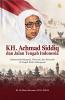
KH. Achmad Siddiq dan Jalan Tengah Indonesia: Rekonstruksi Maqasid, Ukhuwah, dan Pancasila di Tengah Krisis Kebangsaan
Keywords:
KH. Achmad Siddiq, Krisis Kebangsaan, Rekonstruksi Maqāṣid al-Shariah, Ukhuwah, PancasilaSynopsis
Buku ini mengkaji pemikiran KH. Achmad Siddiq sebagai salah satu intelektual dan ulama penting dalam pembentukan corak keberislaman dan kebangsaan Indonesia. Gagasan jalan tengah, dalam buku ini, bukan sekadar sikap kompromistis, melainkan kerangka pemikiran yang mempertemukan komitmen keislaman, kemanusiaan, persaudaraan, dan kebangsaan. Pemikiran tersebut dibaca melalui tiga poros utama: maqāṣid al-sharī‘ah, ukhuwah, dan Pancasila. Ketiganya dianalisis sebagai konsep yang memungkinkan relasi antara Islam dan negara, agama dan kebangsaan, serta identitas keagamaan dan kehidupan bersama dipahami secara lebih proporsional.
Melalui pembacaan historis, filosofis, dan konseptual, buku ini merekonstruksi pemikiran KH. Achmad Siddiq sekaligus menghubungkannya dengan persoalan kebangsaan kontemporer. Perhatian diberikan pada pentingnya menjaga keseimbangan antara normativitas agama dan realitas sosial, antara identitas keislaman dan pluralitas Indonesia, serta antara kebebasan beragama dan tanggung jawab terhadap kehidupan kebangsaan. Buku ini ditujukan bagi akademisi, mahasiswa, peneliti, serta pembaca yang ingin memahami pemikiran Islam Indonesia, hubungan Islam dan Pancasila, serta relevansi gagasan KH. Achmad Siddiq bagi penguatan kehidupan kebangsaan yang inklusif dan berkeadaban.
Downloads
Download data is not yet available.
References
Abadi, M., Arraki, R., dkk. (2023). Analysis of paradigm shift toward the transformation of Nahdlatul Ulama’s political orientation. Analisa: Journal of Social Science and Religion. https://journal.blasemarang.id/index.php/analisa/article/view/1950
Akmaliah, W., & Nadzir, I. (2024). The elective affinity of Islamic populism, mobilization and social media: A case study of Indonesian political identity within the three elections. Studia Islamika. https://studiaislamika.ppimcensis.or.id/index.php/studia-islamika/article/view/36305
Aminuddin, L. H. (2020). Islam Nusantara and progressive Islam: Nahdlatul Ulama and Muhammadiyah’s view on relationship of religion and culture. https://repository.iainponorogo.ac.id/1635/
Arif, S. (2020). Islam dan Pancasila pasca Reformasi: Pandangan kritis Nahdlatul Ulama. Tashwirul Afkar. http://tashwirulafkar.or.id/index.php/afkar/article/view/30
Arifianto, A. R. (2013). Moral authority leadership and progressive Islamic discourse. SSRN. https://papers.ssrn.com/sol3/papers.cfm?abstract_id=2305692
Arifianto, A. R. (2017). Practicing what it preaches? Understanding the contradictions between pluralist theology and religious intolerance within Indonesia’s Nahdlatul Ulama. Al-Jami’ah: Journal of Islamic Studies. https://www.aljamiah.or.id/AJIS/article/view/55201
Arifin, A. Z. (2013). Charisma and rationalisation in a modernising pesantren: Changing values in traditional Islamic education in Java. Western Sydney University. https://researchers.westernsydney.edu.au/files/94853353/uws_17130.pdf
Aspinall, E., & Mietzner, M. (2019). Indonesia’s democratic paradox: Competitive elections amidst rising illiberalism. Bulletin of Indonesian Economic Studies. https://www.tandfonline.com/doi/abs/10.1080/00074918.2019.1690412
Asy’ari, H. (2015). Relasi negara dan Islam di Indonesia: Pengalaman Nahdlatul Ulama. Jurnal Keamanan Nasional. http://ojs.ubharajaya.ac.id/index.php/kamnas/article/view/12
Auda, J. (2008). Maqasid al-Shariah as philosophy of Islamic law: A systems approach. International Institute of Islamic Thought.
Azisi, A. M. A. M., & Moefad, A. M. (2022). NU and nationalism: A study of KH. Achmad Shiddiq’s trilogy of ukhuwah as an effort to nurture nationalism spirit of Indonesian Muslims. Islamuna: Jurnal Studi Islam. https://www.researchgate.net/publication/367661391
Barton, G., Yilmaz, I., & Morieson, N. (2021). Authoritarianism, democracy, Islamic movements and contestations of Islamic religious ideas in Indonesia. Religions, 12(8), 641. https://www.mdpi.com/2077-1444/12/8/641
Bourdieu, P. (1986). The forms of capital. In J. G. Richardson (Ed.), Handbook of theory and research for the sociology of education. Greenwood.
Bourdieu, P. (1991). Language and symbolic power. Harvard University Press.
Budiatri, A. P. (2025). Dynamic tolerance: Tolerance within Nahdlatul Ulama and Nahdliyin in Indonesia. TRaNS: Trans-Regional and National Studies of Southeast Asia. https://www.cambridge.org/core/journals/trans-trans-regional-and-national-studies-of-southeast-asia/article/dynamic-tolerance-tolerance-within-nahdlatul-ulama-and-nahdliyin-in-indonesia/9707F72D873B4B6813EC463CCB626EE8
Burhani, A. N. (2012). Al-Tawassuṭ wa-l I‘tidāl: The NU and moderatism in Indonesian Islam. Asian Journal of Social Science, 40(5–6), 564–581. https://brill.com/view/journals/ajss/40/5-6/article-p564_3.xml
Bush, R. (2000). Redefining political Islam in Indonesia: Nahdlatul Ulama and Khittah ’26. Studia Islamika. https://studiaislamika.ppimcensis.or.id/index.php/studia-islamika/article/view/709
Bush, R. (2002). Islam and civil society in Indonesia: The case of the Nahdlatul Ulama [Doctoral dissertation, University of Washington]. https://search.proquest.com/openview/5b6922f8a83bec6c7fb7831cc0c31fae/1
Bush, R. (2009). Nahdlatul Ulama and the struggle for power within Islam and politics in Indonesia. ISEAS Publishing. https://books.google.com/books?id=Ssg0aiSEyy0C
Damm, M. R. (2018). The (trans)formation of religious capital in Indonesian politics during New Order era: A case study of Nahdlatul Ulama. Journal of Indonesian Social Sciences and Humanities. https://ejournal.brin.go.id/jissh/article/view/8630
Fairclough, N. (1992). Discourse and social change. Polity Press.
Fairclough, N. (1995). Critical discourse analysis: The critical study of language. Longman.
Faiz, M. (2021). Legasi KH Achmad Siddiq bagi umat Islam, negara dan bangsa Indonesia. UIN Kiai Haji Achmad Siddiq Jember. https://digilib.uinkhas.ac.id/11762/1/VISI%20KEBANGSAAN%20KH%20ACHMAD%20SIDDIQ_Muhammad%20Faiz.pdf
Faiz, M. (n.d.). Pandangan kebangsaan KH Hasyim Asy’ari dan KH Ahmad Shiddiq. UIN Kiai Haji Achmad Siddiq Jember. https://digilib.uinkhas.ac.id/11758/1/NKRI%20%26%20VISI%20KEBANGSAAN%20NU_Muhammad%20Faiz.pdf
Faisal, A., Pabbajah, M., Abdullah, I., dkk. (2022). Strengthening religious moderatism through the traditional authority of kiai in Indonesia. Cogent Social Sciences. https://www.tandfonline.com/doi/abs/10.1080/23311886.2022.2150450
Farih, A. (2019). Konsistensi Nahdlatul Ulama dalam mempertahankan Pancasila dan kedaulatan Negara Kesatuan Republik Indonesia. https://scholar.archive.org/work/lynl3svpx5bspjtcatghw3ubfy/
Fawaid, I. (2022). Post-independence NU dynamics towards the establishment of the NU outline as a decision of the Situbondo Congress 1945–1984. El Tarikh. https://ejournal.radenintan.ac.id/index.php/eltarikh/article/view/9267
Fealy, G. (2012). Ijtihad politik ulama: Sejarah NU 1952–1967. LKiS. https://books.google.com/books?id=a71mDwAAQBAJ
Fealy, G., & Bush, R. (2014). The political decline of traditional ulama in Indonesia: The state, umma and Nahdlatul Ulama. Asian Journal of Social Science, 42(5), 536–560. https://brill.com/view/journals/ajss/42/5/article-p536_4.xml
Feillard, A. (1997). Traditionalist Islam and the state in Indonesia. In R. W. Hefner & P. Horvatich (Eds.), Islam in an era of nation-states. University of Hawai‘i Press.
Gadamer, H.-G. (2004). Truth and method (2nd rev. ed.). Continuum.
Ghofir, J. (2017). Pancasila dan Nahdlatul Ulama dalam bingkai Negara Kesatuan Republik Indonesia. Tadris. http://ejournal.iainutuban.ac.id/index.php/tadris/article/view/39
Halid, A. (2022). Actualization of thinking KH. Ahmad Shiddiq about education leadership of national insight. Managiere. https://jurnalpasca.uinkhas.ac.id/index.php/MANAGIERE/article/view/1424
Hamdi, A. Z., Shofwan, M., & Muhammad, A. (2019). Peran organisasi Islam moderat dalam menangkal ekstremisme kekerasan. UIN Sunan Ampel Surabaya. http://repository.uinsa.ac.id/id/eprint/828/
Hasan, N. (2018). Islamic literatures of the millennials: Transmission, appropriation, and contestation. UIN Sunan Kalijaga Yogyakarta. https://digilib.uin-suka.ac.id/id/eprint/48412/
Hasanah, U., Anam, K., & Muassomah, M. (2024). Modernising tradition: Reinforcing ASWAJA al-Nahdhiyah authority among millennials in Indonesia. HTS Teologiese Studies. https://www.scielo.org.za/scielo.php?pid=S0259-94222024000100043&script=sci_arttext
Hosen, N. (2004). Nahdlatul Ulama and collective ijtihad. New Zealand Journal of Asian Studies. https://nzasia.org.nz/wp-content/uploads/2025/10/6_1_2_Hosen-2004-June.pdf
Humaidi, Z. (2010). Islam dan Pancasila: Pergulatan Islam dan negara periode kebijakan asas tunggal. https://www.neliti.com/publications/37097/islam-dan-pancasila-pergulatan-islam-dan-negara-periode-kebijakan-asas-tunggal
Isbah, M. F. (2020). Pesantren in the changing Indonesian context: History and current developments. https://pdfs.semanticscholar.org/c9e6/16844f4235cdca47894859f2ccc1336d0824.pdf
Ismail, F. (2011). The Nahdlatul Ulama: Its early history and contribution to the establishment of Indonesian state. Journal of Indonesian Islam. https://jiis.uinsa.ac.id/index.php/JIIs/article/view/88
Jati, W. R. (2022). Polarization of Indonesian society during 2014–2020: Causes and its impacts toward democracy. https://pdfs.semanticscholar.org/994c/91d080b99e31674280e85cad5ff235f841c0.pdf
Jones, S. (1984). The contraction and expansion of the umat and the role of the Nahdatul Ulama in Indonesia. Indonesia. https://www.jstor.org/stable/3350842
Kamali, M. H. (2012). Maqasid al-Shari‘ah, ijtihad and civilisational renewal. International Institute of Advanced Islamic Studies. https://books.google.com/books?id=XSxjEAAAQBAJ
Kholili, M., Izudin, A., & Hakim, M. L. (2024). Islamic proselytizing in digital religion in Indonesia: The challenges of broadcasting regulation. Cogent Social Sciences. https://www.tandfonline.com/doi/abs/10.1080/23311886.2024.2357460
Khuluq, L. (1997). Kyai Haji Hasyim Asy’ari’s religious thought and political activities, 1871–1947 [Doctoral dissertation, McGill University]. https://mcgill.scholaris.ca/items/493bd184-c8e8-4989-9b0f-a8c5927c8b2f
Kuswana, D. (2024). Digital counter-radicalism: The strategic role of religious organisations in shaping moderate Islam in Indonesia’s cyber realm. Khazanah Theologia. https://khazanah.uinsgd.ac.id/index.php/kt/article/view/33369
Lutfiasari, D. (2018). Modernisasi pendidikan tasawuf KH Achmad Siddiq. UIN Kiai Haji Achmad Siddiq Jember. https://digilib.uinkhas.ac.id/20809/1/Dina%20Lutfiasari_084%20141%20334.pdf
Mietzner, M. (2020). Authoritarian innovations in Indonesia: Electoral narrowing, identity politics and executive illiberalism. Democratization. https://www.tandfonline.com/doi/abs/10.1080/13510347.2019.1704266
Moesa, A. M. (2012). Kiai NU dalam paradigma politik kebangsaan. Al-Daulah. https://jurnalfsh.uinsa.ac.id/index.php/aldaulah/article/view/80
Muhtarom, A., Fuad, S., & Latif, T. (2020). Moderasi beragama: Konsep, nilai, dan strategi pengembangannya di pesantren. Yayasan Talibuana Nusantara. https://books.google.com/books?id=SdYeEAAAQBAJ
Muizzuddin, M. (2023). The Islamic moderation: A literature review of the concept Islamic moderation according to KH. Ahmad Siddiq. At-Thiflah. https://jurnal.insida.ac.id/index.php/atthiflah/article/view/428
Munhanif, A. (1996). The Khittah of 1926 reexamined: Views of the NU in post-Cipasung Congress. Studia Islamika. https://studiaislamika.ppimcensis.or.id/index.php/studia-islamika/article/view/808
Muslih, M. (2019). The role of Nahdlatul Ulama in fighting for religious moderation in Indonesia. https://repository.uingusdur.ac.id/420/1/Peran%20Nahdlatul%20Ulama.pdf
Mustofa, M. (2016). Konsep Islam dan negara menurut KH. Achmad Siddiq. Al-Daulah: Jurnal Hukum dan Perundangan Islam. https://jurnalfsh.uinsa.ac.id/index.php/aldaulah/article/view/115
Mustofa, M. Y., Mas’ud, A., dkk. (2023). Hybrid pesantren in Indonesia: Analyzing the transformation of Islamic religious education in the digital age. Tadris: Jurnal Keguruan dan Ilmu Tarbiyah. https://ejournal.radenintan.ac.id/index.php/tadzkiyyah/article/view/16928
Muthalib, S. A. (2023). Tipologi pemikiran fikih Nahdlatul Ulama. Legitimasi. https://jurnal.ar-raniry.ac.id/index.php/legitimasi/article/view/15995
Muthohirin, N. (2021). Da’wa in social media: The views of Ustad Hanan Attaki and Felix Siauw to the hijrah phenomenon. Afkaruna. https://eprints.umm.ac.id/id/eprint/6676/
Muvid, M. B., Wahyudi, M., dkk. (2024). Tasawuf kebangsaan dalam menumbuhkan nasionalisme dan harmoni sosial. El-Banat. https://ejournal.kopertais4.or.id/susi/index.php/elbanat/article/view/4094
Naila, T. M., & Rohimi, P. (2024). Digital da’wah: The role of YouTube in enhancing religious literacy among Nahdlatul Ulama youth. Fuaduna. https://ejournal.uinbukittinggi.ac.id/fuaduna/article/view/9028
Ni’am, S., & Nurhayati, A. (2018). Pemikiran kebangsaan KH Achmad Siddiq dan implikasinya dalam memantapkan ideologi Pancasila sebagai dasar negara di Indonesia. Akademika. https://scholar.archive.org/work/usq5qrcwujdd3lfv45ad5bp2re/access/wayback/http://e-journal.metrouniv.ac.id/index.php/akademika/article/download/1106/1055
Nisa, E. F., & Saenong, F. F. (2022). Relegitimizing religious authority: Indonesian gender-just ʿulamāʾ amid COVID-19. Religions, 13(6), 485. https://www.mdpi.com/2077-1444/13/6/485
Nolte, A. J. (2023). The Indonesian difference: Pesantren and Indonesian Islam. In Islamic education in Indonesia. Springer. https://link.springer.com/chapter/10.1007/978-3-031-35609-4_15
Pribadi, Y. (2013). Religious networks in Madura: Pesantren, Nahdlatul Ulama and kiai as the core of santri culture. Al-Jami’ah: Journal of Islamic Studies. https://aljamiah.or.id/index.php/AJIS/article/view/151
Rahman, M. H. T., & Harisudin, M. N. (2023). Pemikiran KH. Achmad Siddiq tentang relasi agama dan negara di Indonesia. Constitution Journal. https://constitution.uinkhas.ac.id/index.php/cj/article/view/73
Raya, M. K. F. (2025). Digital Islam: New space for authority and religious commodification among Islamic preachers in contemporary Indonesia. Contemporary Islam. https://link.springer.com/article/10.1007/s11562-024-00570-z
Reid, A., & Gilsenan, M. (2008). The political contingency of reformmindedness in Indonesia’s Nahdlatul Ulama: Interest politics and the Khittah. https://api.taylorfrancis.com/content/chapters/edit/download?identifierName=doi&identifierValue=10.4324/9780203933404-16&type=chapterpdf
Rohmad, A. K. A. (2021). Becoming an Indonesian Muslim: The idea of religious nationalism KH Ahmad Wahid Hasyim 1945–1953. Dinika. https://ejournal.uinsaid.ac.id/dinika/article/view/4142
Salendra, I. W. (2024). Religious moderation in digital media discourse: A study of the NU.or.id portal from the perspective of communicative rationality. Fikri: Jurnal Kajian Agama, Sosial dan Budaya. https://pdfs.semanticscholar.org/2ebd/9b52a0770e24c06a6a3a8b9329871c798cb7.pdf
Setiawan, A., Mushodiq, M. A., dkk. (2022). Implementation of the Nahdlatul Ulama’s brotherhood trilogy concept in pandemic COVID-19 mitigation. https://scholar.archive.org/work/vhjgb6hsxngsnf6udqnaya7g5m/
Setiawan, K. M. P., & Tomsa, D. (2023). Defending a vulnerable yet resilient democracy: Civil society activism in Jokowi’s Indonesia. Journal of Current Southeast Asian Affairs. https://journals.sagepub.com/doi/abs/10.1177/18681034231209058
Siddiq, K. H. Achmad. (n.d.). Al-Fikru an-Nahdliyah.
Siddiq, K. H. Achmad. (n.d.). Khittah Nahdliyah.
Siddiq, K. H. Achmad. (n.d.). Pedoman berpikir Nahdlatul Ulama.
Siregar, K. T., Zhakypkazy, I., & Uyuni, B. (2025). Indonesian muballigh and religious authority: From sanad to algorithmic transformation of Islamic knowledge transmission in the digital era. Jurnal Indo-Islamika. https://journal.uinjkt.ac.id/index.php/indo-islamika/article/view/47052
Sitompul, E. M. (2011). NU & Pancasila. LKiS. https://books.google.com/books?id=pFlnDwAAQBAJ
Soderborg, S., & Muhtadi, B. (2023). Resentment and polarization in Indonesia. Journal of East Asian Studies. https://www.cambridge.org/core/journals/journal-of-east-asian-studies/article/resentment-and-polarization-in-indonesia/0206D9912664832A5A66AD0FC868D07F
Sulhan, M., & Khoiruddin, H. (2017). Transformation of the education of moderate Muslim society: A thought study of Nahdlatul Ulama. Jurnal Pendidikan Islam. https://journal.uin-suka.ac.id/tarbiyah/JPI/article/view/1453
Sulhan, M. (2018). Deradikalisasi Islam Indonesia: Studi pemikiran Islam Nahdlatul Ulama. UIN Sunan Gunung Djati Bandung. https://digilib.uinsgd.ac.id/4869/
Syafa’at, A. K. (2021). KH. Ahmad Siddiq Jember dalam implementasi fikih siyasah di Indonesia. https://prosiding.uinponorogo.ac.id/index.php/cilip/article/view/534
Syahputra, I., Riyanto, W. F., Pratiwi, F. D., dkk. (2024). Escaping social media: The end of netizen’s political polarization between Islamists and nationalists in Indonesia? https://www.tandfonline.com/doi/abs/10.1080/01296612.2023.2246726
Tajfel, H., & Turner, J. C. (1979). An integrative theory of intergroup conflict. In W. G. Austin & S. Worchel (Eds.), The social psychology of intergroup relations. Brooks/Cole.
Thohir, M. (2022). Islam and local wisdom: The study of Islam Nusantara in the cultural perspective. E3S Web of Conferences. https://www.e3s-conferences.org/articles/e3sconf/abs/2022/26/e3sconf_icenis2022_04004/e3sconf_icenis2022_04004.html
Toriq, N. R. S. (2022). Dialogue of religion and country: The thought of KH. A. Wahid Hasyim. Hunafa: Jurnal Studia Islamika. https://mail.jurnalhunafa.org/index.php/hunafa/article/view/655
Triantoro, D. A. (2024). Navigating the digital landscape: How Nahdlatul Ulama volunteers use social media for organizational promotion. Islam Transformatif. https://ejournal.uinbukittinggi.ac.id/islamt/article/view/8656
van Bruinessen, M. (1990). Indonesia’s ulama and politics: Caught between legitimising the status quo and searching for alternatives. Prisma: The Indonesian Indicator. https://dspace.library.uu.nl/server/api/core/bitstreams/ebfe5bc7-8858-4c51-aff9-2d3ea48177cf/content
van Bruinessen, M. (1996). Traditions for the future: The reconstruction of traditionalist discourse within NU. https://www.academia.edu/download/3991530/bruinessen_traditions_for_the_future.pdf
van Dijk, T. A. (1998). Ideology: A multidisciplinary approach. Sage.
van Dijk, T. A. (2006). Politics, ideology, and discourse. In K. Brown (Ed.), Encyclopedia of language & linguistics (2nd ed.). Elsevier.
Warburton, E. (2020). Deepening polarization and democratic decline in Indonesia. In T. Power & E. Warburton (Eds.), Democracy in Indonesia: From stagnation to regression? ISEAS–Yusof Ishak Institute. https://www.jstor.org/stable/resrep26920.8
Weber, M. (1978). Economy and society: An outline of interpretive sociology. University of California Press.
Yenuri, A. A., Islamy, A., Aziz, M., dkk. (2021). Paradigma toleransi Islam dalam merespons kemajemukan hidup di Indonesia: Studi analisis pemikiran KH Ahmad Shiddiq. https://www.academia.edu/download/89161940/216-Article_Text-547-1-10-20220121.pdf
Yilmaz, I., & Barton, G. (2021). Political mobilisation of religious, chauvinist, and technocratic populists in Indonesia and their activities in cyberspace. Religions, 12(10), 822. https://www.mdpi.com/2077-1444/12/10/822
Published
September 23, 2026
Categories
Copyright (c) 2026 kaifama
License

This work is licensed under a Creative Commons Attribution-ShareAlike 4.0 International License.
This work is licensed under a Creative Commons Attribution-ShareAlike 4.0 International License (CC BY-SA 4.0).
How to Cite
Ali Hasan Siswanto. (2026). KH. Achmad Siddiq dan Jalan Tengah Indonesia: Rekonstruksi Maqasid, Ukhuwah, dan Pancasila di Tengah Krisis Kebangsaan. Kaifama. https://press.kaifama.id/books/catalog/book/7